Adsterra

Black Sicklebill

Black Sicklebill
The Black Sicklebill, Epimachus fastuosus, is a large bird of paradise of midmountain forests of New Guinea. The male has black plumage with iridescent green, blue and purple scale-like feathers, red irises, bright yellow mouth, long curved black bill, huge sabre-shaped tail and large erectile fan-like plumes on the sides of its breast. The female is smaller than the male, with reddish brown plumage, brown irises, and buff below. Reaching up to 110 cm in length, the male Black Sicklebill is the longest member of Paradisaeidae, though the Curl-crested Manucode has a larger body.The Sicklebill's diet consists mainly of fruits and arthropods. The male of the species is polygamous and performs a horizontal courtship display with the pectoral plumes raised around its head. In the wild, the bird has hybridised with the Arfak Astrapia to create offspring that were once considered a distinct species, the Elliot's Sicklebill (Epimachus ellioti). While some believe this was a valid species that is possibly critically endangered or extinct, it is generally viewed by most mainstream ornithologists as a hybrid. Due to ongoing habitat loss, small population size, and hunting in some areas for food and its tail feathers, the Black Sicklebill is classified as Vulnerable on the IUCN Red List of Threatened Species. It is listed on Appendix II of CITES.
source:
link:pic


The Sarus Crane

The Sarus Crane

The Sarus Crane (Grus antigone) is a large non-migratory crane found in parts of the Indian Subcontinent, Southeast Asia and Australia. The tallest of the flying birds, standing at a height of up to 1.8 m (5.9 ft), they are conspicuous and iconic species of open wetlands. The Sarus Crane is easily distinguished from other cranes in the region by the overall grey colour and the contrasting red head and upper neck. They forage on marshes and shallow wetlands for roots, tubers, insects, crustaceans and small vertebrate prey. Like other cranes, they form long-lasting pair-bonds and maintain territories within which they perform territorial and courtship displays that include loud trumpeting, leaps and dance-like movements. In India they are considered symbols of marital fidelity, believed to mate for life and pine the loss of their mates even to the point of starving to death. The main breeding season is during the rainy season, when the pair builds an enormous nest "island", a circular platform of reeds and grasses nearly two metres in diameter and high enough to stay above the shallow water surrounding it. Sarus Crane numbers have declined greatly in the last century and it has been estimated that the current population is a tenth or less (perhaps 2.5%) of the numbers that existed in the 1850s. The stronghold of the species is India, where it is traditionally revered and lives in agricultural lands in close proximity to humans. Elsewhere, the species has been extirpated in many parts of its former range.
source:
link:pic


African spurred tortoise

African spurred tortoise

The African spurred tortoise is native to the Sahara Desert and the Sahel, a transitional ecoregion of semiarid grasslands, savannas, and thorn shrublands found in the countries of Burkina Faso, Chad, Eritrea, Ethiopia, Mali, Mauritania, Nigeria, Senegal, and Sudan In these arid regions, the tortoise excavates burrows in the ground to get to areas with higher moisture levels, and spends the hottest part of the day in these burrows. This is known as aestivation. Burrows may average 30 inches in depth; some dig tunnel systems extending 10 feet or more underground. Size and lifespan G. sulcata is the third-largest species of tortoise in the world after the Galapagos tortoise, and Aldabra giant tortoise, and the largest of the mainland tortoises. Adults are usually 24 to 36 in long (60–90 cm) and can weigh 100-200 lb (45 – 91 kg). They grow from hatchling size (2-3 in) very quickly, reaching 6-10 in (15–25 cm) within the first few years of their lives. The lifespan of an African spurred tortoise is about 50-150 years, though they can live much longer. (The oldest in captivity is 54 years, located in the Giza Zoological Gardens, Egypt, 1986).
source:
link:pic

Paradise Riflebird

Paradise Riflebird

The Paradise Riflebird, Ptiloris paradiseus, is a medium-sized, up to 30 cm long, passerine bird of the Paradisaeidae (Birds of Paradise) family. The male is black with an iridescent greenish blue crown, throat and central tail feathers. It has a black curved bill, black feet, dark brown iris and yellow mouth. The female is an olive brown bird with barred blackish below. Endemic to eastern Australia, the Paradise Riflebird is distributed to rainforests of New South Wales and central Queensland. The diet consists mainly of insects and fruits. In displays, the male extends his wings and fans them upward with its head behind the wings to expose his metallic green throat feathers. He then moves his head from side to side with open bill to show off his bright yellow mouth. The Paradise Riflebird is evaluated as Least Concern on the IUCN Red List of Threatened Species. It is listed on Appendix II of CITES.
source:
link:pic
wikipedia

The Redbone

The Redbone

The Redbone Coonhound has a lean, muscular, well proportioned build. The body type is typical to the coonhounds subgroup, with long straight legs, a wide barrel chest, and a head and tail that is held high and proud when hunting or showing. The Redbone's face is often described as having a pleading expression, with sorrowful dark brown or hazel eyes and long, drooping ears. Their coat is short and smooth against the body, but coarse enough to provide protection to the skin while hunting through dense underbrush. Their paws have especially thick pads and are also webbed and dewclaws are common. The nose should be black and prominent. The ears are floppy and should extend to nearly the end of the nose if stretched out. Coloration of the nose is always black and the coat color is always a rich red, though a small amount of white on the chest, between the legs, or on the feet is permissible, though not preferred. Variations of black fur on the face and muzzle are also not uncommon. The toes are typically webbed.
Males should be 22-27 inches (56-68.5 cm) at the shoulder, with females slightly shorter at 21-26 inches (53–66 cm). Weight should be proportional to the size and bone structure of the individual dogs, with a preference towards leaner working dogs rather than heavier dogs. Generally, weights will range from 45 to 70 lbs (20.5 to 31.75 kg).
source:
link:pic
wikipedia

Bandog

Bandog
The original Bandogs were bred with a functional purpose, as were all working breeds, and for the Bandog this purpose revolved around guarding and protecting. The Bandogs of old were strictly working dogs, often of various crosses and various sizes. The name "Bandog" was then not a breed, it was a description of a duty or purpose. Usually these dogs were coarse-haired hunters, fighters and property protectors without a strictly set type, developed from eastern shepherds and mastiffs crossed with western Bullenbeissers and hounds, with a few local bloodlines eventually being established as specific types in some regions, such as Britain, Spain, Germany, Poland and elsewhere in Europe.[citation needed] Early incarnations of the Bandog probably had bloodlines from bull baiting dogs and the Guardian Mastiffs or the cross of both like the war dogs used in the Crusades.[citation needed] William Harrison, in his description of England during 1586, first mentions the type in his statement, "Bandogge which is a huge dog, stubborn, uglier, eager, burthenouse of bodie, terrible and fearful to behold and often more fierce and fell than any Archadian or Corsican cur." It is assumed that the word "Bandogge" originated from the use of strong bonds and chains to secure the dogs.[In 1576, Dr. Caius states that, among others characteristics, the "Mastiff or Bandogge is serviceable against the fox and the badger, to drive wild and tame swine out of meadows, and pastures, to bite and take the bull by the ears, when occasion so required." 
source:
link:pic


Plott Hound

Plott Hound

Appearance The Plott Hound should be athletic, muscular, and agile in appearance. It should be neither low-set and heavy, nor leggy and light: it has medium build. Its expression should be one of intelligence, confidence, and determination. Its skin should not be baggy like that of a Bloodhound. The Plott is a strongly built yet moderate hound, with a distinct brindle-colored coat. Their appearance suggests the capacity for speed, stamina and endurance. The Plott may have an identification mark on the hound used to identify the dog when out hunting. Such a mark is not penalized in conformation shows. Coat and color The Plott Hound's hair should be fine to medium in texture, short or medium in length, and have a smooth and glossy appearance. According to the National Plott Hound Association, the dog's hair should be brindled. Brindled is defined as "Finely streaked or striped effect or pattern of black or tan hairs with hairs of a lighter or darker background color. Shades of colors accepted: yellow brindle, red brindle, tan brindle, brown brindle, black brindle, grey brindle, and maltese (slate grey, blue brindle)." Acceptable colors are any of the above mentioned brindles. Black with brindle trim in the alternative. The Association dictates that while some white on chest and/or feet is permissible, white anywhere else, except on chest and/or feet, is a fault. Size Plott Hounds are approximately 22 to 27 in (55 to 71 cm) at the withers for males, 21 to 25 in (53 to 63 cm) for females. Males should weigh 50 to 75 lb (23 to 27 kg). Females should weigh 40 to 65 lb (18 to 25 kg)
source:
pic:

Pufferfish

pufferfish

Tetraodontidae is a family of primarily marine and estuarine fish of the order Tetraodontiformes. The family includes many familiar species, which are variously called pufferfish, puffers, balloonfish, blowfish, bubblefish, globefish, swellfish, toadfish, toadies, honey toads, sugar toads, and sea squab. They are morphologically similar to the closely related porcupinefish, which have large external spines (unlike the thinner, hidden spines of Tetraodontidae, which are only visible when the fish has puffed up). The scientific name refers to the four large teeth, fused into an upper and lower plate, which are used for crushing the shells of crustaceans and mollusks, their natural prey. Pufferfish are generally believed to be the second most poisonous vertebrates in the world, after the golden poison frog. Certain internal organs, such as liver, and sometimes the skin, are highly toxic to most animals when eaten; nevertheless, the meat of some species is considered a delicacy in Japan (as 河豚, pronounced as fugu), Korea (as bok), and China (as 河豚 hétún) when prepared by chefs who know which part is safe to eat and in what quantity. The Tetraodontidae contain at least 120 species of puffers in 19 genera. They are most diverse in the tropics and relatively uncommon in the temperate zone and completely absent from cold waters. They are typically small to medium in size, although a few species can reach lengths of greater than 100 centimetres (39 in).
source:
link:pic

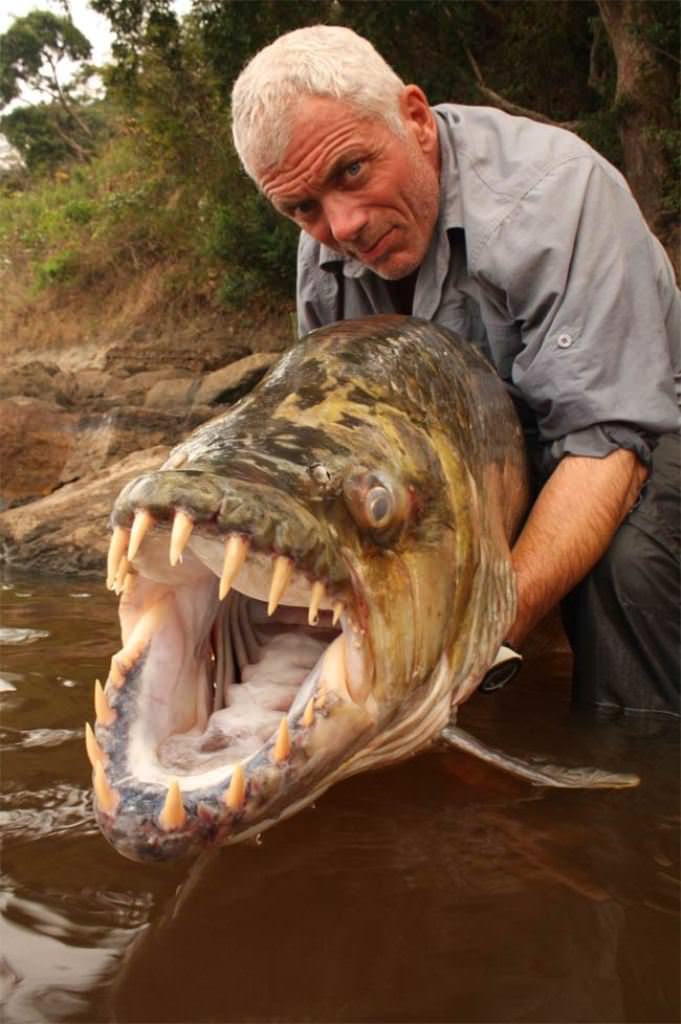
Hydrocynus goliath

Hydrocynus goliath

Hydrocynus goliath, also known as the goliath tigerfish, giant tigerfish, or mbenga, is a very large African predatory freshwater fish in the family Alestidae.
Hydrocynus goliath is found in the Congo River Basin (including Lualaba River and Lake Upemba), and Lake Tanganyika. A study published in 2011 revealed several mtDNA clades in this region, suggesting a higher tigerfish species richness than traditionally recognized. If confirmed, this would restrict H. goliath to the Congo River Basin. Four additional species (H. vittatus and three undescribed species) appear to be present in this Basin, while two (H. vittatus and an undescribed species) appear to be present in Lake Tanganyika.

source:
link:

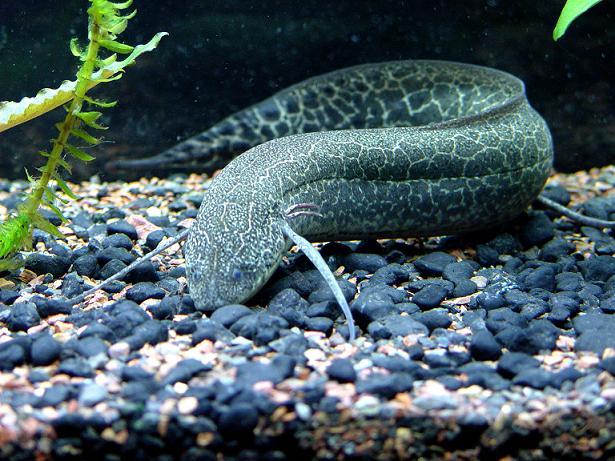
African lunghfish

African lunghfish

The African lungfishes are the genus Protopterus and constitute the four species of lungfish found in Africa. Protopterus is the sole genus in the family Protopteridae.
African lungfishes are elongated, eel-like fishes, with thread-like pectoral and pelvic fins. They have soft scales, and the dorsal and tail fins are fused into a single structure. They can either swim like eels, or crawl along the bottom, using their pectoral and pelvic fins. The largest species reach about 200 centimetres (6.6 ft) long. African lungfishes generally inhabit shallow waters, such as swamps and marshes; however, they are also found in larger lakes such as Lake Victoria. They can live out of water for many months in burrows of hardened mud beneath a dried-up stream bed. They are carnivorous, eating crustaceans, aquatic insect larvae, and molluscs.

source :
link: pic