Adsterra

Showing posts with label cats. Show all posts

British Shorthair

British Shorthair


The British Shorthair is a domesticated cat whose features make it a popular breed in cat shows. It has been the most popular breed of cat registered by the UK's Governing Council of the Cat Fancy (GCCF) since 2001, when it overtook the Persian breed British Shorthairs have dense, plush coats that are often described as crisp or cracking, referring to the way the coat breaks over the contours of the cat's body. Their eyes are large, round and widely set and can be a variety of colours, though the copper or gold eyes of the British blue are the best known. Their heads are round with full, chubby cheeks and their bodies are large and muscular. The breed has a broad chest and shoulders, short legs, round paws and a plush tail with a blunt tip, the tail commonly has dark rings around it at the near bottom.The males of this breed are larger than the females, and the size difference between them is more easily noticed compared to other breeds. The males' average weight is 5-10 kilograms, whereas a female weighs up to 5–7 kilograms. The silver shaded variety is generally much smaller with females being 2.6-3.5 kilograms and males being 4.2-5 kilograms. As with many breeds, the adult males may also develop prominent cheek jowls that distinguish them from their female counterparts
source:
link:pic
wikipedia


Munchkin short leg cat

Munchkin short leg cat


The Munchkin Cat is a relatively new breed of cat characterized by its very short legs, which are caused by a naturally occurring genetic mutation. It has been named after the "munchkin" doughnut. Much controversy erupted over the breed when it was recognized by The International Cat Association in 1995 with critics voicing concern over potential health and mobility issues.Short-legged cats have been documented a number of times around the world since the 1940s. A British veterinary report in 1944 noted four generations of healthy short-legged cats which were similar to normal cats except for the length of the legs. This line disappeared during the Second World War but other short-legged cats were spotted in Russia during 1956 and the United States in the 1970s. In Russia the cat earned the nickname "Stalingrad Kangaroo cat".
source:
link:pic
wikipedia

Savannah cat

Savannah cat


A Savannah cat is a cross between a domestic cat and the serval, a medium-sized, large-eared wild African cat. The unusual cross became popular among breeders at the end of the 1990s, and in 2001 the International Cat Association accepted it as a new registered breed. In May 2012, TICA accepted it as a championship breed. Savannahs are much more social than typical domestic cats, and they are often compared to dogs in their loyalty. They can be trained to walk on a leash and to play fetch.Bengal breeder Judee Frank crossbred a male serval, belonging to Suzi Woods, with a Siamese (domestic cat) to produce the first Savannah cat (named Savannah) on April 7, 1986.Frank’s Savannah attracted the interest of Patrick Kelley, who purchased one of Savannah's kittens in 1989. Kelley was one of the first enthusiasts who worked towards establishing a new domestic breed based on a serval/domestic cat cross. He approached many serval breeders to help in the development of this new breed, and finally garnered the help of breeder Joyce Sroufe to work with him in taking the steps needed to have the new breed.
source:
link:pic
link


Bengal Cat

Bengal Cat


The Bengal is a hybrid breed of domestic cat. Bengals result from crossing a domestic feline with an Asian leopard cat (ALC), Prionailurus bengalensis bengalensis.The Bengal cat has a desirable "wild" appearance with large spots, rosettes, and a light/white belly, and a body structure reminiscent of the ALC. The Bengal possesses a gentle domestic cat temperament, if separated by at least four generations from the original crossing between a domestic feline and an ALC.The name "Bengal cat" was derived from the taxonomic name of the Asian leopard cat (P. b. bengalensis), and not from the more distantly related Bengal tiger.
source:
link:pic
wikipedia


Siamese Cat

Siamese Cat


The Siamese ( RTGS: Wichianmat) is one of the first distinctly recognized breeds of Oriental cat. The breed originated in Thailand (formerly known as Siam), where they are one of several native breeds and are called Wichian Mat ( a name meaning "moon diamond"). In the 20th century the Siamese cat became one of the most popular breeds in Europe and North America.The pointed cat known in the West as "Siamese", recognized for its distinctive markings, is one of several breeds of cats from Siam described and illustrated in manuscripts called "Tamra Maew" (Cat Poems), estimated to have been written from the 14th to the 18th century.
source:
link:pic
wikipedia
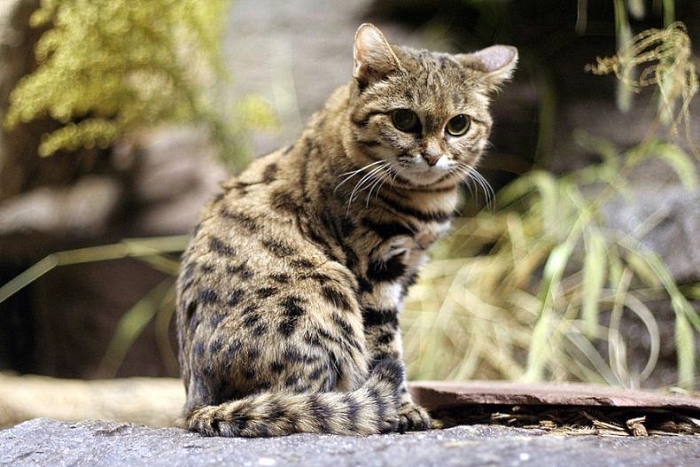
Persian (cat)

Persian (cat)

The Persian is a long-haired breed of cat characterized by its round face and shortened muzzle. Its name refers to Persia, the former name of Iran, where similar cats are found.[dubious – discuss] Recognized by the cat fancy since the late 19th century, it was developed first by the English, and then mainly by American breeders after the Second World War. In Britain, it is called the Longhair or Persian Longhair. The selective breeding carried out by breeders has allowed the development of a wide variety of coat colors, but has also led to the creation of increasingly flat-faced Persians. Favored by fanciers, this head structure can bring with it a number of health problems. As is the case with the Siamese breed, there have been efforts by some breeders to preserve the older type of cat, the traditional breed, having a more pronounced muzzle, which is more popular with the general public. Hereditary polycystic kidney disease is prevalent in the breed, affecting almost half the population in some countries.
soruce:
link:pic
wikipedia
Maine Coon

Maine Coon


The Maine Coon, also known as American Longhair, is a breed of domestic cat with a distinctive physical appearance and valuable hunting skills. It is one of the oldest natural breeds in North America, specifically native to the state of Maine, where it is the official state cat.Although the Maine Coon's exact origins and date of introduction to the United States are unknown, many theories have been proposed. The breed was popular in cat shows in the late 19th century, but its existence became threatened when long-haired breeds from overseas were introduced in the early 20th century. The Maine Coon has since made a comeback and is now one of the most popular cat breeds in the world.
source:
link:pic
wikipedia


Ragdoll

Ragdoll

The Ragdoll is a cat breed with blue eyes and a distinct colorpoint coat. It is a large and muscular semi-longhair cat with a soft and silky coat. Developed by American breeder Ann Baker , it is best known for its docile and placid temperament and affectionate nature. The name "Ragdoll" is derived from the tendency of individuals from the original breeding stock to go limp and relaxed when picked up.The docile and floppy nature of the Ragdoll is a characteristic thought to be passed down from the Persian and Birman breed. Opinions vary as to whether this trait might be the result of genetic mutation. The extreme docility of some individuals has led to the myth that Ragdolls are pain-resistant.
source:
link:pic
wikipedia

Asian Golden Cat

Asian Golden Cat


The Asian golden cat (Pardofelis temminckii, syn. Catopuma temminckii), also called the Asiatic golden cat and Temminck's cat, is a medium-sized wild cat of Southeastern Asia. In 2008, the IUCN classified Asian golden cats as Near Threatened, stating that the species comes close to qualifying as Vulnerable due to hunting pressure and habitat loss, since Southeast Asian forests are undergoing the world's fastest regional deforestation rates.The Asian golden cat was named in honor of the Dutch zoologist Coenraad Jacob Temminck, who first described the African golden cat in 1827.
source:
link:pic
wikipedia


Black Footed Cat

Black Footed Cat


The black-footed cat (Felis nigripes) is the smallest African cat, and is endemic in the south west arid zone of the southern African subregion. It is one of the lesser studied African carnivores, and is listed as Vulnerable by IUCN since 2002.The black-footed cat is one of the smallest cat species. Adult resident males weigh on average 1.9 kg (4.2 lb) and a maximum of 2.45 kg (5.4 lb). Adult resident females weigh on average 1.3 kg (2.9 lb) and a maximum of 1.65 kg (3.6 lb).[3] Males reach a head-to-body length of 36.7 to 43.3 cm (14.4 to 17.0 in) with tails 16.4 to 19.8 cm (6.5 to 7.8 in) long. Females are smaller with a maximum head-to-body-length of 36.9 cm (14.5 in) and taills 12.6 to 17.0 cm (5.0 to 6.7 in) long.
source:
link:pic
wikipedia.

Jungle Cat


Jungle Cat
The jungle cat (Felis chaus) is a medium-sized cat native to Asia from southern China in the east through Southeast and Central Asia to the Nile Valley in the west. It is listed as Least Concern in the IUCN Red List of Threatened Species as it is widespread and common particularly in India. Population declines and range contraction are of concern, particularly in Egypt, in the Caucasus, and in southwestern, Central and Southeast Asia.
source:
link:pic
wikipedia


Sand Cat

Sand Cat


The sand cat (Felis margarita), also known as the sand dune cat, is the only felid found primarily in true desert, and has a wide but apparently disjunct distribution through the deserts of northern Africa and southwest and central Asia. Since 2002 this small cat has been listed as Near Threatened by IUCN due to concern over potential low population size and decline.Sand cats are found in both sandy and stony desert, living in areas far from water. Having thickly furred feet they are well adapted to the extremes of a desert environment, and tolerant of extremes of hot and cold temperatures.Victor Loche first described the sand cat in 1858 from a specimen found in the Sahara. He proposed to name the species in recognition of Jean Auguste Margueritte who headed the expedition into the Sahara.
source:
link:pic
wikipedia


Burmese Cat

Burmese Cat


The Burmese Suphalak meaning fortunate, beautiful, and splendid appearance) is a breed of domesticated cats split into two subgroups: the American Burmese and the British Burmese (and are not to be confused with "Sacred Cat of Burma," in respect of which, see Birman). Most modern Burmese are descendants of one female cat called Wong Mau, which was brought from Burma to America in 1930. Most cat registries do not recognize a split between the two groups, but those that do formally refer to the type developed by British cat breeders as the European Burmese.Originally, Burmese cats were exclusively dark brown (sable), but years of selective breeding have produced a wide variety of colors. Different associations have different rules about which of these count as Burmese. Burmese cats are known for being sociable and friendly with humans, as well as very intelligent. They are also very vocal, and often call to their owners.

source:
link:pic
wikipedia


The wildcat

The wildcat


The wildcat (Felis silvestris) is a small cat found throughout most of Africa, Europe, and southwest and central Asia into India, China, and Mongolia. Because of its wide range, it is classed by the IUCN as Least Concern. However, crossbreeding with housecats is extensive and has occurred throughout almost the entirety of the species' range.The wildcat shows a high degree of geographic variation. Asiatic subspecies have spotted, isabelline coats, African subspecies have sandy-grey fur with banded legs and red-backed ears, and European wildcats resemble heavily built striped tabbies with bushy tails, white chins and throats. All subspecies are generally larger than house cats, with longer legs and more robust bodies. The actual number of subspecies is still debated, with some organisations recognising 22, while others recognise only four, including the Chinese mountain cat, which was previously considered a species in its own right.
source:
link:pic
wikipedia


fishing cat

fishing cat
The fishing cat (Prionailurus viverrinus) is a medium-sized wild cat of South and Southeast Asia. In 2008, the IUCN classified the fishing cat as Endangered since they are concentrated primarily in wetland habitats, which are increasingly being settled, degraded and converted. Over the last decade, the fishing cat population throughout much of its Asian range declined severely.Like its closest relative, the leopard cat, the fishing cat lives along rivers, streams and mangrove swamps. It is well adapted to this habitat, being an eager and skilled swimmer.
source:
link:pic
wikipedia


The Canada lynx

 The Canada lynx

The Canada lynx (Lynx canadensis) or Canadian lynx is a North American mammal of the cat family, Felidae. It is a close relative of the Eurasian Lynx (Lynx lynx). However, in some characteristics the Canada lynx is more like the bobcat (Lynx rufus) than the Eurasian Lynx. With the recognised subspecies, it ranges across Canada and into Alaska as well as some parts of the northern United States.With a dense silvery-brown coat, ruffed face and tufted ears, the Canada lynx resembles the other species of the mid-sized Lynx genus. It is larger than the bobcat, with which it shares parts of its range, and over twice the size of the domestic cat.
source:
link: pic
wikipedia

African wildcat

African wildcat


The African wildcat (Felis silvestris lybica), also called Near Eastern wildcat, is a wildcat subspecies that occurs across North Africa and around the periphery of the Arabian Peninsula to the Caspian Sea. As the wildcat is a common and widely distributed cat species it is listed as Least Concern by IUCN since 2002.The wildcat subspecies are estimated to have diverged 230,000 years ago. The ancestor of the African wildcat and the domestic cat is estimated to have diverged about 131,000 years ago. Wildcats were domesticated over 9,000 years ago in the Near East where African wildcats currently occur. Remains of a domestic cat were found in a human grave in Cyprus aged at 9,500 years ago.
source:
link:pic
wikipedia

Margay Cat

Margay Cat
The margay is very similar to the larger ocelot in appearance, although the head is a little shorter, the eyes larger, and the tail and legs longer. It weighs from 2.6 to 4 kilograms (5.7 to 8.8 lb), with a body length of 48 to 79 centimetres (19 to 31 in), and a tail length of 33 to 51 centimetres (13 to 20 in). Unlike most other cats, the female possesses only two teats.The fur is brown in color, and marked with numerous rows of dark brown or black rosettes and longitudinal streaks. The undersides are paler, ranging from buff to white, and the tail has numerous dark bands and a black tip. The backs of the ears are black with circular white markings in the centre. Most notably the margay is a much more skillful climber than its relative, and it is sometimes called the tree ocelot because of this ability. Whereas the ocelot mostly pursues prey on the ground, the margay may spend its entire life in the trees, leaping after and chasing birds and monkeys through the treetops. Indeed, it is one of only two cat species with the ankle flexibility necessary to climb head-first down trees (the other being the clouded leopard). It is remarkably agile; its ankles can turn up to 180 degrees, it can grasp branches equally well with its fore and hind paws, and it is able to jump up to 12 feet (3.7 m) horizontally.The margay has been observed to hang from branches with only one foot. Its look is also similar to the oncilla, a small jungle feline.

source:
linkpic

Ginger Cat

Ginger Cat

The Ginger Cat  is a collection of plays by Anglo-Irish fantasy writer Lord Dunsany, edited and with an introduction by Darrell Schweitzer. It was first published in hardcover and paperback by Wildside Press in 2005. The collection includes three of Dunsany's more obscure plays, only two of them previously acted and only one previously published. "The Ginger Cat," a comedy, in production in summer, 1914, was canceled at the outbreak of World War I. "The Murderers," a crime melodrama, had one known performance in 1919, at Yale University during a visit by the playwright. "Mr. Faithful," another comedy, was written and performed in 1922; an acting edition published by Samuel French in 1935 is now a rarity. The editor reproduced the first two plays from Dunsany's manuscripts, and the third from a photcopy of the acting edition.
source:
link:pic
wikipedia

The BobCat

The BobCat
The bobcat (Lynx rufus) is a North American mammal of the cat family Felidae, appearing during the Irvingtonian stage of around 1.8 million years ago (AEO). With 12 recognized subspecies, it ranges from southern Canada to northern Mexico, including most of the continental United States. The bobcat is an adaptable predator that inhabits wooded areas, as well as semidesert, urban edge, forest edges, and swampland environments. It persists in much of its original range, and populations are healthy. With a gray to brown coat, whiskered face, and black-tufted ears, the bobcat resembles the other species of the mid-sized Lynx genus. It is smaller on average than the Canada lynx, with which it shares parts of its range, but is about twice as large as the domestic cat. It has distinctive black bars on its forelegs and a black-tipped, stubby tail, from which it derives its name. Though the bobcat prefers rabbits and hares, it will hunt anything from insects, chickens, and small rodents to deer. Prey selection depends on location and habitat, season, and abundance. Like most cats, the bobcat is territorial and largely solitary, although with some overlap in home ranges. It uses several methods to mark its territorial boundaries, including claw marks and deposits of urine or feces.The bobcat breeds from winter into spring and has a gestation period of about two months. Although bobcats have been hunted extensively by humans, both for sport and fur, their population has proven resilient. The elusive predator features in Native American mythology and the folklore of European settlers.

source:
link:pic
wikipedia